
Your brand is trust. And trust is built—or broken—before care is delivered.
In the eyes of the consumer, the lines between healthcare and the broader service economy have all but disappeared. Whether ordering delivery, booking a hotel, or making a doctor’s appointment, people expect the same things: seamless access, clear communication, and experiences that feel both personal and safe.
At the center of this transformation? A redefined consumer experience—where every touchpoint, from search to scheduling to service delivery, contributes to brand trust.
Today’s healthcare consumers are digitally savvy and informed. They research, compare, and validate their options with the same rigor they bring to any major purchase. And while this trend isn’t new, it’s deepening in its complexity.
Press Ganey conducted a nationwide survey of healthcare consumers to learn how they move from search to selection, and from first impression to long-term loyalty, today. Our “Healthcare consumer experience 2025” report expands on the latest patient experience data to map this journey in detail—and pinpoint the moments that make or break trust.
These insights reveal a new strategic imperative: trust and loyalty are built long before clinical care begins. Understanding—and optimizing—these early decision points is key to winning in today’s competitive market.
The healthcare experience begins before the first appointment
Before a patient even walks through your doors, your brand has already spoken to them, and first impressions are already being formed—through search results, online listings, patient reviews, and other digital touchpoints.
This kind of digital hygiene sets the tone for the healthcare experience, directly reflecting your brand’s reliability. Outdated listings, broken links, and conflicting contact information introduce friction in the healthcare journey and frustrate consumers. Worse yet, they erode trust, and can lead patients to walk right into a competitor's office.
What would discourage you from booking an appointment with a provider?
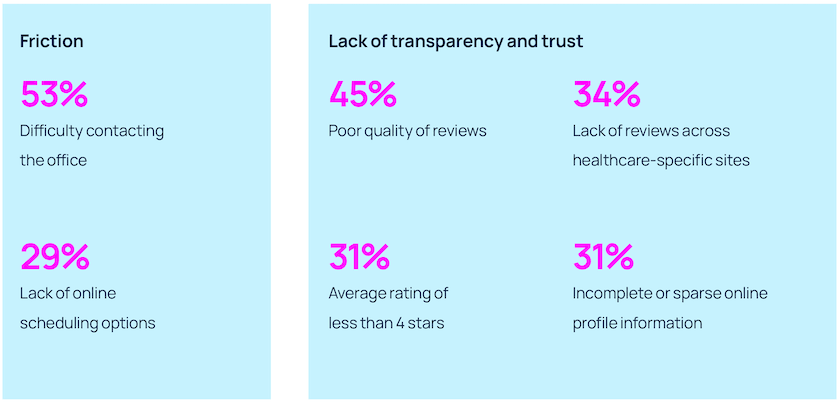
For 72% of consumers, the healthcare journey starts the same way as any other decision: with a Google search. But exactly how they search varies. 20% start by looking for a type of specialist, 15% by symptoms or conditions, and 14% by provider name. Another 11% begin with the hospital or clinic name.
And what drives that final choice? Whether a provider accepts their insurance is the top consideration for 51% of consumers. Still, that’s only the baseline. They’re also evaluating specialty expertise (45%), location (42%), and appointment availability (38%).
Online patient reviews are today’s most powerful referrals
In a world of generative AI-powered search, ratings and reviews are the currency of credibility. Consumers read an average of five to seven reviews before booking care, and 84% would reconsider seeing a referred provider if their rating fell below 4 stars.
And it’s not just star ratings. Google AI Overviews, ChatGPT, and other answer engines now pull summary insights from websites as well as provider reviews—elevating transparency into instant social proof.
To stay competitive, organizations must move beyond passive review management. They need to actively invite and publish feedback, and respond authentically when warranted.
Access is still healthcare’s Achilles’ heel
Despite progress in digital transformation, appointment scheduling remains the #1 frustration for healthcare consumers and the most cited barrier to care.
Many journeys break down during this last mile. Consumers are ready to act, but are too often met with outdated systems, phone-based communications, and clunky scheduling tools. These legacy workflows sabotage brand equity. They create gaps between consumer expectations and operational reality—gaps that show up in lost revenue, lower satisfaction, and patient churn.
We’re living in the age of AI Overviews and one-click conversions, yet too many health systems are still asking people to “please hold.” That’s a failure of both design and strategy. Today’s consumers want seamless handoffs across every channel, from Google Search to your front desk. Every manual process—from phone-only booking to voicemail appointment reminders—introduces friction. That friction becomes a filter.
How social capital behind the scenes shapes care, experience, and brand perception
What happens inside the organization shapes what’s experienced outside. When employees collaborate well, patient loyalty follows.
This is what we call social capital—the hidden framework of experience. It’s the behind-the-scenes teamwork that powers front-line excellence. Internal alignment. Respect. Shared purpose. When those elements are intentionally nurtured, they show up in interactions that patients describe as “empathetic,” “seamless,” and “trustworthy.”
Organizations with strong social capital consistently outperform on the key metrics that drive consumer trust and loyalty. They're 2.4x more likely to lead on “doctor listened carefully,” 2x on “staff worked together to care for you,” and 1.6x on “rate the hospital.”
The numbers reveal what consumers value most: empathy, teamwork, and communication. But these signals of trust don’t originate in patient rooms. They start in break rooms and team huddles.
Loyalty is emotional—based on how people feel, not just what they get
Consumers don’t stay loyal because of one excellent visit. They stay because of consistency. Because they feel seen and heard—across every interaction. In this year’s data, loyalty is mostly driven by customer service, appointment availability, and communication, not price.
This tells us something vital: In a landscape increasingly driven by tech, connection still wins. AI may expedite, but only human empathy can deepen trust.
Healthcare organizations must treat the consumer experience as a strategic imperative that drives patient acquisition and financial performance. It’s a key differentiator that guides consumers to your brand—and the glue that keeps them loyal. Because, in the Human Experience economy, your brand isn’t built through marketing; it's built in the moment.
If safety is the foundation, and access the front door, then “brand” is the feeling patients are left with. That feeling is built through human connection—and it’s that connection that keeps them coming back.
Download our latest consumer experience report for the full analysis. To learn how to reach and convert more healthcare consumers, build social capital within, and drive patient loyalty, reach out to a brand experience expert.