
Engagement on the rebound: New trends and insights
After years of unrelenting pressure, the healthcare workforce is finally showing us something we haven’t seen in quite some time: a real, measurable rebound in both employee and physician engagement. Press Ganey’s latest national insights—reflecting the voices of over 2.6M caregivers in 2025—paint a picture of a workforce that is healing, refocusing, and reconnecting with its purpose.
This shift is no accident. It’s the result of organizations investing meaningfully in listening, transparency, and creating environments where people feel safe, supported, and valued. And the message from caregivers is unmistakable: When the organization commits to them, they commit back.
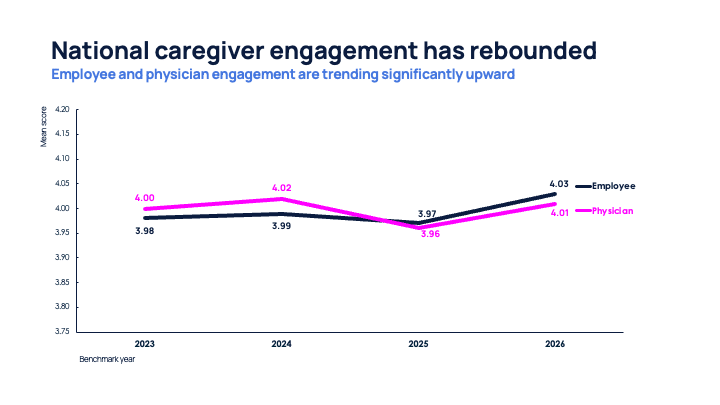
Engagement improves across all roles
Over the past year, engagement scores for both employees and physicians climbed significantly, marking the strongest improvement we’ve seen since before the pandemic. What makes this year especially noteworthy is that the gains aren’t confined to a handful of pockets—they’re happening across the entire ecosystem. Clinical professional, registered nurse (RN), advanced practice provider (APP), clerical, and skilled maintenance roles experienced some of the largest increases since the previous year.
While APP and RN engagement has increased significantly, these two roles continue to report lower engagement (APP at 3.94 and RN at 3.97 on a 5-point scale of agreement) compared to other healthcare roles.
We also continue to see the management gap in engagement perceptions—with senior leader engagement at 4.59 (out of a 5-point scale of agreement), management engagement at 4.27, then a large gap down to 4.09 and below for nonmanagement roles.
These upward trends are a positive indication that organizations who have been investing in employee experience over the last year or two are reaping the rewards for their efforts. For many organizations that have spent the past several years trying to “get back to baseline,” the data suggests a new mindset is needed. This is no longer a recovery phase. It’s a momentum phase. And momentum must be nurtured.
Disengagement continues to indicate turnover risk
Even with the encouraging improvements we’re seeing, the risks tied to disengagement haven’t faded. In fact, they remain stark. Disengaged employees are 2.6x more likely to leave their organization than their highly engaged peers. Between 2024 and 2025, 29% of disengaged employees left. Those who reported feeling neutral weren’t far behind, with 19% turning over.
National turnover remained steady at 18%. But this stability is deceptive. Preventable turnover, especially among early-tenure employees, continues to disrupt teams, strain operations, and have a far-reaching impact across an organization—including negative effects on patient experience. At a time when staffing challenges, inflationary pressures, and increasing care complexity already threaten margins, losing people unnecessarily remains one of the costliest risks organizations face.
As national turnover stabilizes, the financial implications remain substantial. Natural attrition is expected, but preventable turnover continues to threaten operational stability and the patient experience.
What’s driving engagement today
As engagement continues to rebound across the healthcare workforce, the “why” behind this progress is becoming increasingly clear. When we look across millions of employee and physician responses, three themes consistently stand out—each one revealing caregivers’ true priorities, and what organizations must prioritize themselves to maintain this positive momentum.
1. A deep commitment to safety culture
Safety isn’t just a regulatory requirement in healthcare—it’s an emotional anchor. Employees and physicians alike tell us their sense of engagement is closely tied to whether they believe their organization puts safety first, for employees and patients. When individuals feel safe, the organization shows its commitment to safety, and when teams work together to deliver high-quality care, engagement rises.
2. Support and well-being
People need to feel supported—specifically, having a manageable work–life balance as well as the tools and resources to do their jobs effectively. Teams have been pushed to their limits over the past several years, and employees and physicians continue to gravitate toward organizations that prioritize their well-being in meaningful ways.
Beyond boosting engagement, an emphasis on employee support and well-being reinforces a sense of partnership between the caregiver and organization.
3. Trust and alignment with senior leadership
Confidence in senior leadership continues to be a longstanding driver of employee engagement, while alignment between physicians and senior leadership remains a strong driving factor for physician engagement.
When leadership is transparent, communicative, and aligned with frontline realities, employees and physicians feel more connected. But when trust begins to waver, engagement tends to fall just as quickly.
What do these trends mean for healthcare organizations?
The national uptick in engagement is worth celebrating, but it comes with a crucial caveat: The work isn’t done.
As engagement rises, the organizations winning the most ground are those that:
- Strengthen leadership visibility and communication
- Equip teams with the resources they need
- Prioritize well-being and workload management
- Use high reliability principles to build psychological safety within teams
- Listen continuously, and act transparently
At the end of the day, one thing we know is something we’ve always known: Healthcare’s workforce is resilient. Despite the pressures of inflation, staffing shortages, and the rising complexity of care, caregivers remain deeply committed to their calling. And, when organizations invest in them, engagement rebounds.
If you’re looking to stay ahead of emerging engagement trends—or want to be first to access our upcoming employee and physician experience report—our team can help get you started. Reach out anytime to explore your data, identify opportunities, or map out your next steps.